The Problem
Everyone Showed Up Wearing the Same Thing
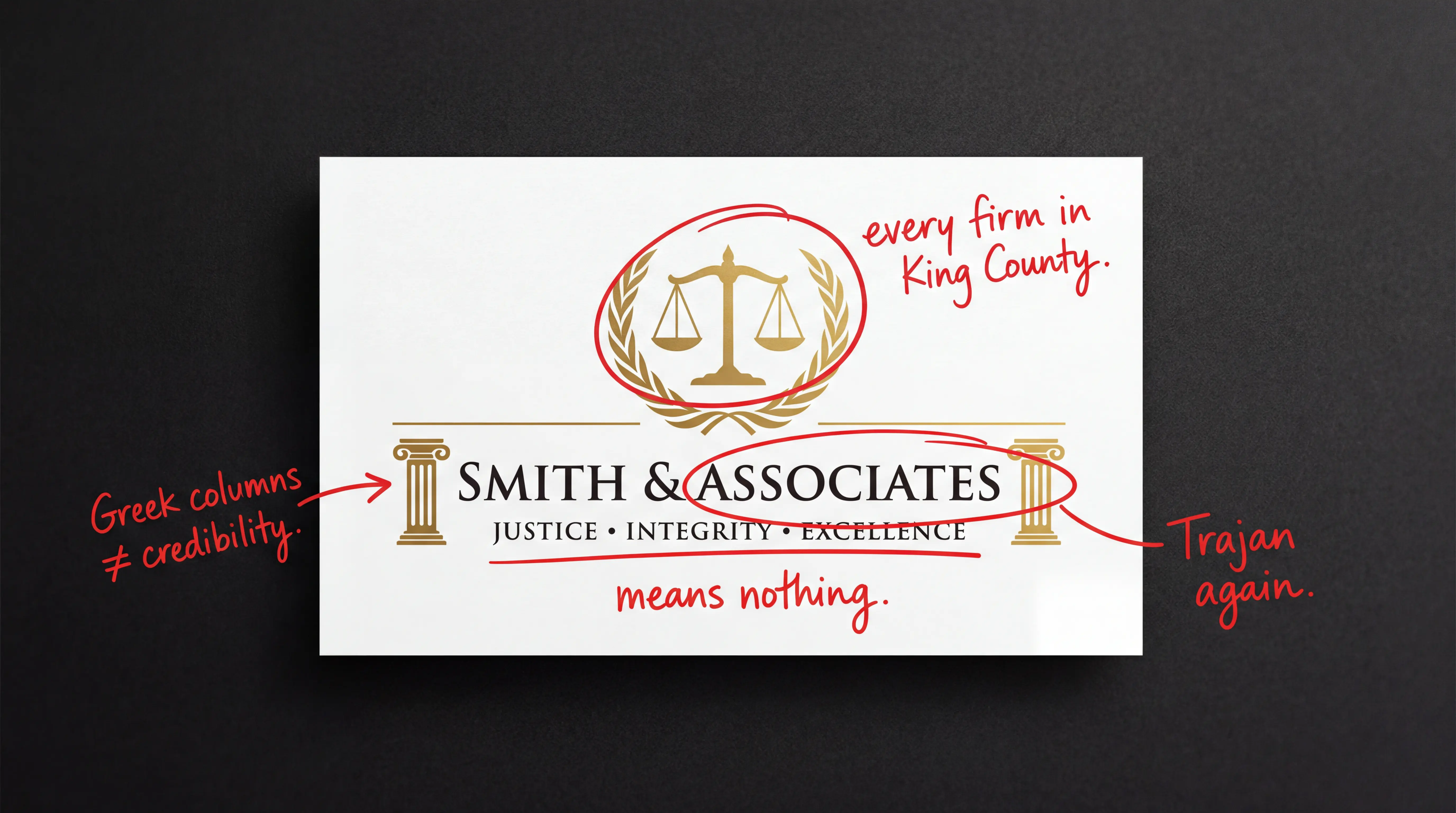
A law firm with scales of justice in the logo. A contractor with a roof silhouette and a hammer crossed behind it like a family crest. A tech startup with a globe made of circuit lines. A dentist with a tooth. A real estate agent with a house. You’ve seen these a thousand times. You couldn’t name a single one.
That’s the problem. Not that these logos are ugly. Some of them are competently drawn, technically clean, perfectly centered on the business card. The problem is they’re cosplay. They’re wearing the costume of an industry instead of representing an actual business. A gavel doesn’t tell me anything about your firm. It tells me you passed the bar. Congratulations. So did forty thousand other attorneys in Washington State.
The instinct makes sense on the surface. Scales mean justice. Hammers mean building. Teeth mean dentist. The logic feels safe - the viewer will immediately know what you do. And that’s exactly why it fails. When every competitor in a category reaches for the same visual shorthand, the symbol stops communicating. It becomes wallpaper. Your logo doesn’t say “hire me”. It says “I exist in this industry,” which is the least interesting thing you could possibly communicate to someone deciding who to call.
The Trap
Obvious Iconography Outsources Your Identity
Flip through the first two pages of Google results for “immigration lawyer Seattle” and count the Statue of Liberty logos. Count the American flags stitched into wordmarks. Count the globes with latitude lines. Now try to remember which firm used which. You can’t. Because they all made the same choice, and the choice canceled itself out. The icon became a category label, not a brand asset.
Roofing companies are worse. I’ve seen the same roof-peak silhouette with a chimney on the left used by contractors in Kirkland, Tacoma, Spokane, and Boise. Four different businesses. Four different markets. One clip-art logo. Their business cards could be shuffled into a single deck and no one would notice the swap.
Here’s the deeper issue: obvious iconography outsources your identity to the category. Instead of building a mark that represents what’s specific about your company. Your positioning, your clients, your approach. You grab the visual equivalent of a name tag that says “HELLO, I AM A LAWYER.” The logo becomes a sign instead of a brand. There’s a difference between a sign that says “dentist” and a brand you remember by name. Signs are functional. Brands are valuable.
And the irony is thick: the business owners who default to industry icons are usually the same ones frustrated that prospects treat them as interchangeable. The logo told them to.
The Brief
You Can’t Design a Mark for a Business You Haven’t Defined
“I want something clean and modern.” I hear this on every first call. It’s not a brief. It’s a vibe. Clean compared to what? Modern according to whom? These words feel specific but they’re empty. They describe an aesthetic preference, not a business identity. And a logo built on preference instead of positioning is a coin flip.
Most logo projects fail before anyone opens Illustrator. They fail in the brief. Or the absence of one. The business owner skips the hard questions. What does this company do that nobody else in its market does the same way? Who is the specific person you’re trying to reach. Not “everyone,” not “businesses,” but the actual human holding their phone at 10pm deciding who to call? What should they feel when they see your name?
A competitive audit takes thirty minutes and changes everything. Pull up every competitor in your market. Screenshot their logos. Lay them out in a grid. If you can draw a circle around the visual patterns. Same colors, same icons, same serif fonts pretending to be “established”. You now have a map of exactly where not to go. The brief writes itself by elimination. You don’t need to be clever. You need to be different from the eleven people who already made the obvious choice.
When the brief is solid. Positioning defined, audience named, competitive landscape mapped. The designer isn’t decorating. They’re translating. That’s a fundamentally different job, and it produces a fundamentally different result.
The Craft
Putting a Whole Business into a Single Mark Is the Hard Part
People think logo design is choosing a font and drawing an icon. That’s like saying architecture is choosing a paint color and drawing a door. The actual work is compression. Taking a company’s positioning, its voice, its audience, its competitive landscape, and distilling all of that into one visual mark that works at 16 pixels on a browser tab and at 16 feet on a building facade. That tension between saying enough and saying nothing is where the craft lives.
It takes weeks, not hours. The first concepts rarely survive contact with the brief, because early ideas tend to be the obvious ones - the industry cosplay your competitors already chose. The good solutions show up after those are exhausted, after the designer has lived inside the brief long enough to find the angle no one else saw. That’s not something you get from a Fiverr turnaround or a Canva template. It’s not something you get by sending three designers the same Pinterest board and picking the cheapest bid. It’s what happens when someone with skill spends real time inside your problem. That is what strategic logo design in Seattle is supposed to look like.
Diagnosis
Five Signs Your Logo Is Working Against You
It Tries to Narrate the Entire Business
A house inside a wrench inside a sun, because the owner couldn’t pick one thing. Three icons crammed into a circle, each one fighting for attention like passengers on a crowded bus. A logo is a mark, not an infographic. The moment you try to explain everything you do inside one symbol, you communicate nothing. The strongest marks say one thing clearly. The weakest try to say everything at once.
It’s Just a Font
No icon. No mark. No system. Just the company name typed in Montserrat or Playfair Display because the designer “liked how it looked.” A wordmark can work. Some of the best logos in the world are typographic. But a wordmark designed with intent is a different animal from a name dropped into a Google Font. The first has custom spacing, weight adjustments, and a mark that functions at every scale. The second falls apart the moment you need a favicon, a social avatar, or a hat embroidery.
It Only Exists in One Context
Designed on a white artboard. Approved on a white screen. Printed on a white business card. Then the day comes when you need it on a dark background, a photograph, a vehicle wrap, a glass door. And it disappears. A logo that wasn’t stress-tested against real-world applications is a logo that works in exactly one place: the designer’s presentation deck. Responsive lockups, reversed colorways, single-color variants. These aren’t extras. They’re the baseline.
You Can Carbon-Date It
Drop shadows. Bevels. Glossy gradients that scream 2011. The three-dimensional chrome effect that every auto shop thought was futuristic fifteen years ago. A logo that leans on trendy effects has a shelf life built into the design. When the trend passes. And it always passes. The mark doesn’t look vintage. It looks neglected. The best logos are deliberately simple because simplicity doesn’t date. A clean mark from 1962 still works. A gradient mesh from 2014 looks like a relic.
It Was Delivered as a JPEG with a White Box
The cousin who “knows Photoshop” designed it. The file is 72 dpi, 400 pixels wide, with a visible white rectangle where the transparency should be. No vector file. No usage guidelines. No color-separated versions. Just a raster image that pixelates on a business card and can’t be printed larger than a postage stamp without looking like it was faxed. If the only file you have is a JPEG or PNG, you don’t have a logo. You have a screenshot of one.
The Point
A Mark That Could Belong to Anyone Belongs to No One
Go back to the law firm with the scales. The logo isn’t broken because it’s poorly drawn. The lines are clean, the kerning is fine, the gold gradient is tasteful enough. It’s broken because it could be peeled off that firm’s website and dropped onto any of the forty-three other immigration practices in King County and nobody would blink.
A logo earns recognition by being specific. Specific to the business it represents, the market it operates in, the people it serves. That specificity doesn’t come from a stock icon library. It comes from the brief. From the audit. From the slow, uncomfortable process of figuring out who you actually are before asking someone to draw it.
The obvious choice is always available. Scales are free. Hammers are free. Globes with circuit lines are free. But a mark that belongs only to you. That takes work. And it’s the only kind worth having.
Questions
Frequently Asked Questions
Why is using industry icons in a logo a bad idea?
When every business in an industry uses the same icon - scales for law firms, hammers for contractors, teeth for dentists. The symbol stops differentiating. It labels the category instead of representing the company. A logo that could belong to any competitor belongs to no one.
What makes a logo memorable?
Memorable logos are built on brand positioning, not industry stereotypes. They translate a company’s specific identity. Its audience, voice, and competitive advantage - into a visual mark. The design process starts with a brief grounded in strategy, not a stock icon library.
Should I design my logo before or after brand strategy?
After. A logo designed without brand clarity is decoration. The brief. Who you serve, what makes you different, how you want to be perceived. Gives the designer something real to translate visually. Without that foundation, you get a mark built on assumptions and personal taste.
How do I know if my logo is bad?
Common signs: the logo uses the same icon as your competitors, it only works on white backgrounds, it was designed without a creative brief, it turns into an unreadable smudge at small sizes, or it was delivered as a JPEG rather than a vector file. If more than one of those applies, the mark isn’t serving you.
Can a well-designed logo use industry-related imagery?
It can, but the reference has to be oblique. Earned through the creative brief, not grabbed from a stock icon set. The best logos reference an industry without cosplaying it. There’s a line between a clever nod and a cliché. A competitive audit and a strong brief keep you on the right side of it.