In This Guide
Build Checklist
What a Fast Landing Page Still Needs
- A clear offer and audience before the technical explanation.
- Compressed media, stable layout, and limited scripts.
- A single next step that fits the business.
- Internal links to the broader website when the landing page is not enough.
The Problem
The WordPress Tax Nobody Told You About
Open your monthly credit card statement and find the line item for web hosting. $15 here. $29 there. Another $12 for the security plugin, $8 for the backup plugin, $24 for the SEO plugin that keeps nagging you to upgrade. Somewhere in the fine print, a “managed WordPress” subscription that renews every year whether you log in or not. For most small businesses, the landing page that was supposed to bring in leads has quietly become a monthly expense that does nothing but exist.
The site itself is slow. You already know this. You open it on your phone at a coffee shop and watch the spinner crawl. The images take three seconds to resolve. The menu flickers. By the time the page settles, a person browsing on a mediocre connection has already hit the back button and tapped the next result. Google logs that behavior. Your rankings slip. Your leads dry up. The plugin updates keep showing up in the dashboard.
This is not a problem with your business. It’s a problem with the stack. A WordPress site is a database query pretending to be a page. Every visit triggers a round trip to a server, a lookup, a render, a response. That architecture made sense in 2005. For a landing page in 2026, it’s like delivering a letter by horse-drawn carriage because the post office still exists. There are better ways now.
The Alternative
Static Site Generation, Without the Jargon
Static site generation means the page is built once, ahead of time, and saved as a plain HTML file. When someone visits, they get that file directly. No database query, no server processing, nothing to wait on. The file is stored on a global content delivery network, which means a copy lives in a data center close to wherever the visitor happens to be. Seattle, Dallas, London, Tokyo. The page loads from the nearest location and arrives almost instantly.
Next.js is the framework that makes this practical. It’s the most widely used React framework in the world, built by a company called Vercel and maintained as open-source code that anyone can use. Next.js handles the complicated parts. Routing, image optimization, SEO metadata, accessibility defaults. So that the finished site arrives in a browser already fast, already responsive, already crawlable by Google.
For a small business landing page, the trade is simple. You give up the WordPress admin panel you weren’t using anyway. You get back speed, security, and a hosting bill that rounds to zero.
The Pedigree
The Same Framework Nike and Netflix Use
Next.js isn’t a scrappy framework somebody whipped up last year. It’s what some of the largest technology and consumer companies in the world run on. Nike builds with it. Netflix and Hulu use it across parts of their streaming platforms. TikTok runs it. Twitch, Notion, DoorDash, The Washington Post, Target, Sonos, Ticketmaster, McDonald’s, and Loom all ship production products on Next.js.
In AI, Next.js is the default. OpenAI’s public marketing sites run on it. Anthropic runs parts of its infrastructure on it. Perplexity, Runway, and Hugging Face all build with it. When the companies training and serving the most sophisticated software in the world pick a web framework for their own landing pages, they pick this one. There’s a reason.
The reason is that Next.js scales from a one-page landing site to a global streaming platform without the underlying architecture changing. A small business gets access to the same framework running those products. The same rendering model, the same image pipeline, the same deployment primitives. Without having to pay for it, rebuild it, or understand how any of it works internally.
The Speed
Speed Isn’t a Nice-to-Have. It’s the Conversion Lever.
Google published the numbers. When page load time goes from one second to three seconds, the probability that a visitor bounces rises 32%. One to five seconds, it rises 90%. One to six, 106%. One to ten, 123%. These aren’t marketing statistics. They come from Google’s own research across billions of real-world page loads.
Amazon calculated that every 100 milliseconds of added load time cost them 1% in sales. Walmart found that every one-second improvement increased conversions by 2%. Pinterest cut load time by 40% and saw signups climb 15% along with search engine traffic. The pattern repeats in every industry that runs the experiment. Fast sites make money. Slow sites lose it.
A Next.js static landing page typically delivers First Contentful Paint in under one second and Largest Contentful Paint in under 1.8 seconds. The thresholds Google uses to classify a site as “good” on Core Web Vitals. Those metrics feed directly into search ranking. A fast site doesn’t just convert better. It gets found more.
For a contractor, a law firm, a dentist. Any small business competing for local search. The speed advantage compounds. Your page shows up higher. More people click. More people stay. More people fill out the form. All from the same piece of software running on the same hosting plan a competitor is paying ten times more for.
In Practice
One Running Example
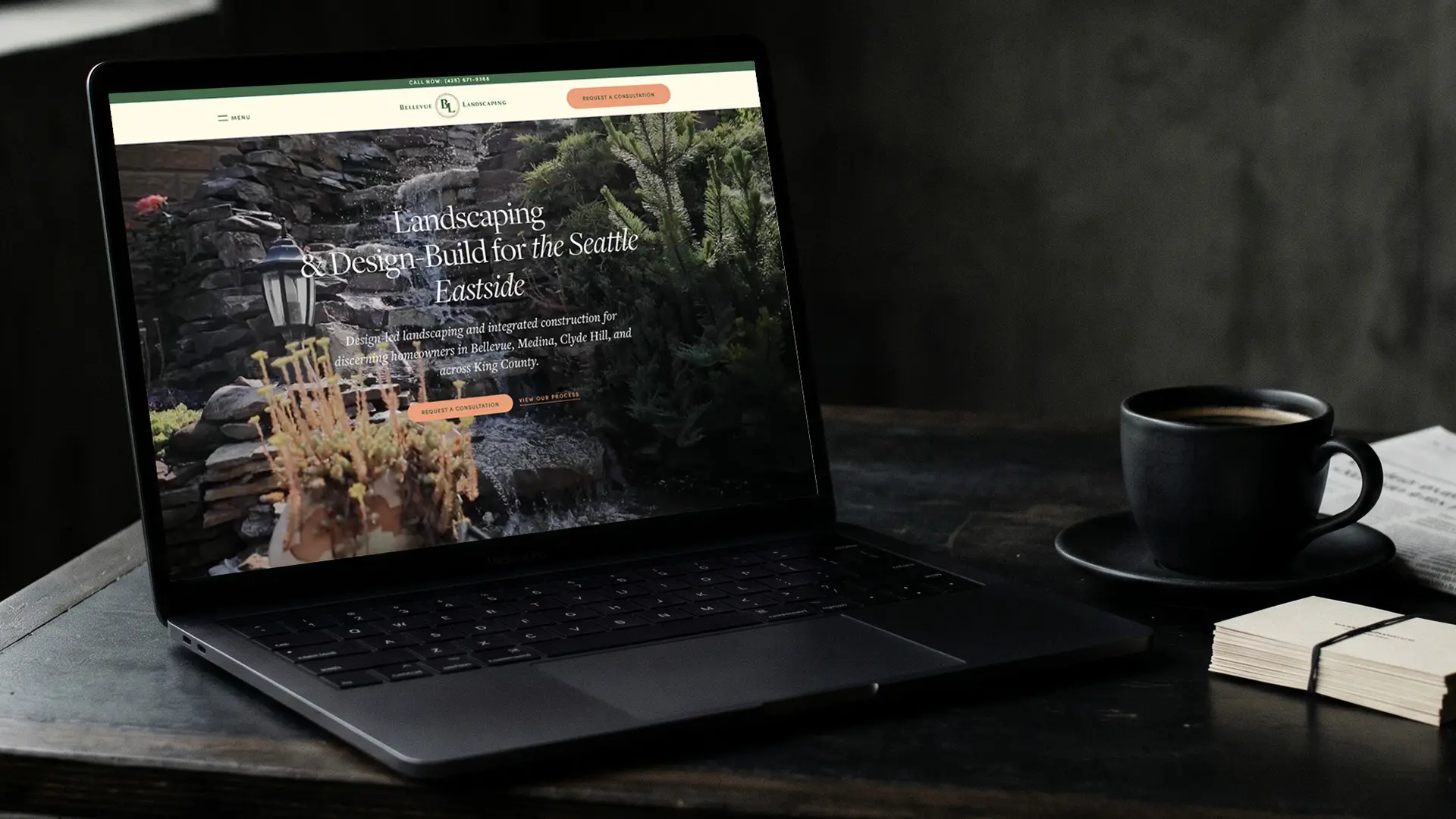
The site pictured at the top of this page is bellevue-landscaping.com - a landscape design and maintenance company on the east side of Seattle. I designed the brand and built the site on Next.js as a static export. Pre-rendered HTML. Served from the edge. Hosted on a free tier. Loads in under a second on a phone, even on a slow connection. No plugin dashboard to maintain, no database to patch, no monthly maintenance retainer bleeding the owner dry.
Everything described in this article. The speed, the hosting economics, the security posture, the SEO defaults. Is running in production for that business right now. More examples on the portfolio.
What You Actually Get
Seven Things a Next.js Static Site Gives You That a WordPress Site Won’t
A Hosting Bill That Rounds to Zero
Vercel’s Hobby plan is free. Cloudflare Pages is free. Netlify’s starter tier is free. Any of the three can host a small business landing page comfortably within the free allotment. If a site grows into real traffic, the paid tiers start around $20 per month. Still a fraction of what most small businesses are paying for managed WordPress.
Nothing to Hack
Static sites have no database, no admin login, no PHP runtime, no plugin ecosystem. The three most common attack vectors for a small business website. An exposed admin panel, an out-of-date plugin, a SQL injection. Don’t exist on a static site. There’s no door because there’s no room behind it. Security incidents drop to near zero because there’s nothing to compromise.
Uptime That Approximates 100%
Static files served from a global CDN are distributed across hundreds of data centers. A single server going down doesn’t take the site with it. Another edge node handles the request. Vercel and Cloudflare routinely report uptime north of 99.99%, which translates to less than an hour of downtime across an entire year.
SEO Built In, Not Bolted On
Next.js generates clean, semantic HTML by default. Metadata, Open Graph tags, schema markup, sitemaps, and canonical URLs are all first-class citizens of the framework. No plugin required, no “upgrade to Pro” prompt blocking the feature. Google crawls the static HTML the same way it crawls the homepage of The Washington Post. Because they’re using the same framework. More on the web design practices that make a small business site rank.
Every Change Is Version Controlled
Content lives in a Git repository, which means every edit is timestamped and reversible. Delete a paragraph by accident? Roll back to yesterday’s version in three clicks. The repository is the backup. There’s no separate “restore from backup” plugin, no monthly fee for a backup service, no 2am panic call when a plugin update breaks the homepage.
Preview URLs for Every Change
Every update to a Next.js site deployed on Vercel or Netlify generates a preview URL automatically. New copy for the services page? Review it on a live link before it goes to production. A small business owner can click, approve, and publish. Without logging into anything more complicated than email.
Mobile Performance Out of the Box
Over 60% of local business searches now happen on a phone. Next.js ships with an image optimization pipeline that serves appropriately sized images for each device, responsive fonts, and mobile-first defaults baked into the framework. The same site that loads in under a second on a desktop connection loads just as fast on a phone standing in a parking lot.
The Hosting
Free or Close to It, Across Every Serious Provider
Three hosting providers cover almost every realistic use case for a small business Next.js site. Vercel’s Hobby tier includes 100 GB of bandwidth, unlimited static deployments, a free subdomain, and automatic HTTPS. All at zero cost. For a typical small business landing page getting a few thousand visitors a month, that allotment is effectively unlimited. Vercel is the company that makes Next.js, so the integration is the tightest.
Cloudflare Pages offers unlimited bandwidth on its free plan with global edge delivery from the same network Cloudflare uses to serve 20% of the web. Netlify offers similar free-tier generosity with 100 GB bandwidth and simple Git-based deployments. Any of the three will serve a small business site reliably, quickly, and without a bill.
If a site eventually grows past the free tier. Enough traffic that bandwidth genuinely matters. The paid plans start around $20 per month. For context: that’s less than the cost of a single mediocre SEO plugin on a WordPress site. The economics don’t just favor static hosting. They embarrass the old model.
The Upkeep
Maintenance, When You Actually Need It
Here’s where most small business owners get nervous. The site is fast and cheap. Great. But what happens when you need to change something? Update a price. Swap out a photo. Add a new service page. Fix a typo the bookkeeper caught.
Green Lake Digital handles those updates on a low-cost hourly basis at $75 per hour, invoiced monthly. Most update requests. A copy edit, a new image, a seasonal banner. Take less than an hour. A new service page or a structural addition might run two to four. At the end of the month, I send a single invoice itemizing the time spent. No retainer. No minimum. No recurring charge sitting on your card whether you needed help or not.
The hourly model works because a well-built static site rarely needs emergency attention. There’s no database to migrate, no plugin conflict to resolve, no SSL certificate that mysteriously stopped renewing. The same architectural choices that make the site cheap to host make it cheap to maintain. Most months, there’s nothing to bill for. Some months it’s a single hour. Some months it’s a bigger project and you know the cost before it starts.
For a small business that’s been paying $150 a month in hosting, plugins, and “maintenance retainers” to an agency that barely answers email, the math is straightforward. The new site is faster, the new stack is cheaper, and help is available when you actually need it - not billed against whether you do.
The Point
The Stack Finally Caught Up to What a Small Business Actually Needs
For twenty years, the default answer for a small business landing page was WordPress. That was never because WordPress was the right tool. It was because WordPress was the available one. Hosting was slow, frameworks were for engineers, and the average small business owner was willing to trade performance for the ability to log in and type a paragraph into a dashboard. Fair enough. The trade made sense given the options.
The options changed. Next.js and the static-site model it runs on made fast, cheap, durable websites accessible to anyone willing to have one built. The same framework running Nike’s ecommerce platform runs the landing page of the one-person law firm down the street. The speed, the security, the global distribution. All available at free-tier hosting.
The WordPress tax was never a necessary cost of doing business. It was a default that outlived its usefulness. A Next.js static site is what a small business landing page looks like when it’s built for lead generation instead of the developer who made it.
Questions
Frequently Asked Questions
What is a Next.js static site?
A website where every page is built once as a plain HTML file and served from a global content delivery network. No database, no server processing per visit, no login panel to secure. The visitor gets the same file sitting on a server in the closest data center, which is why it loads almost instantly.
Why is Next.js good for small business websites?
Sites load in under a second, cost close to nothing to host, require no database maintenance, and rarely break. For a small business running a landing page focused on lead generation, that combination produces a site that ranks well in Google, converts visitors at a higher rate, and doesn’t eat into monthly overhead.
What companies use Next.js?
Nike, Netflix, TikTok, Hulu, Twitch, Notion, OpenAI, Anthropic, The Washington Post, DoorDash, Target, Sonos, Ticketmaster, and many others run production workloads on Next.js. The framework scales from a solo landing page to global streaming infrastructure without changing the underlying architecture.
How much does it cost to host a Next.js static site?
Free to about $20 per month depending on traffic. Vercel’s Hobby tier, Cloudflare Pages, and Netlify’s starter tier all offer generous free plans that handle the traffic level of most small business landing pages. A custom domain costs $12 to $15 per year separately.
How fast does a Next.js static site load?
A well-built Next.js static site typically loads in under one second on modern connections. Static files served from a CDN skip the database lookups and server rendering that slow down traditional WordPress sites. Google’s Core Web Vitals data shows bounce rate rises 32% when load time goes from one to three seconds. Speed is a direct conversion lever.
Do I need ongoing maintenance for a Next.js site?
Far less than a WordPress site. No database to patch, no plugins to update, no admin login to secure. For content updates. New copy, new photos, a new service page. Green Lake Digital handles the work on a low-cost hourly basis at $75 per hour, invoiced monthly. No retainer, no minimum, no recurring charge whether you needed help or not.